DJing in the classroom: a practical guide for music teachers
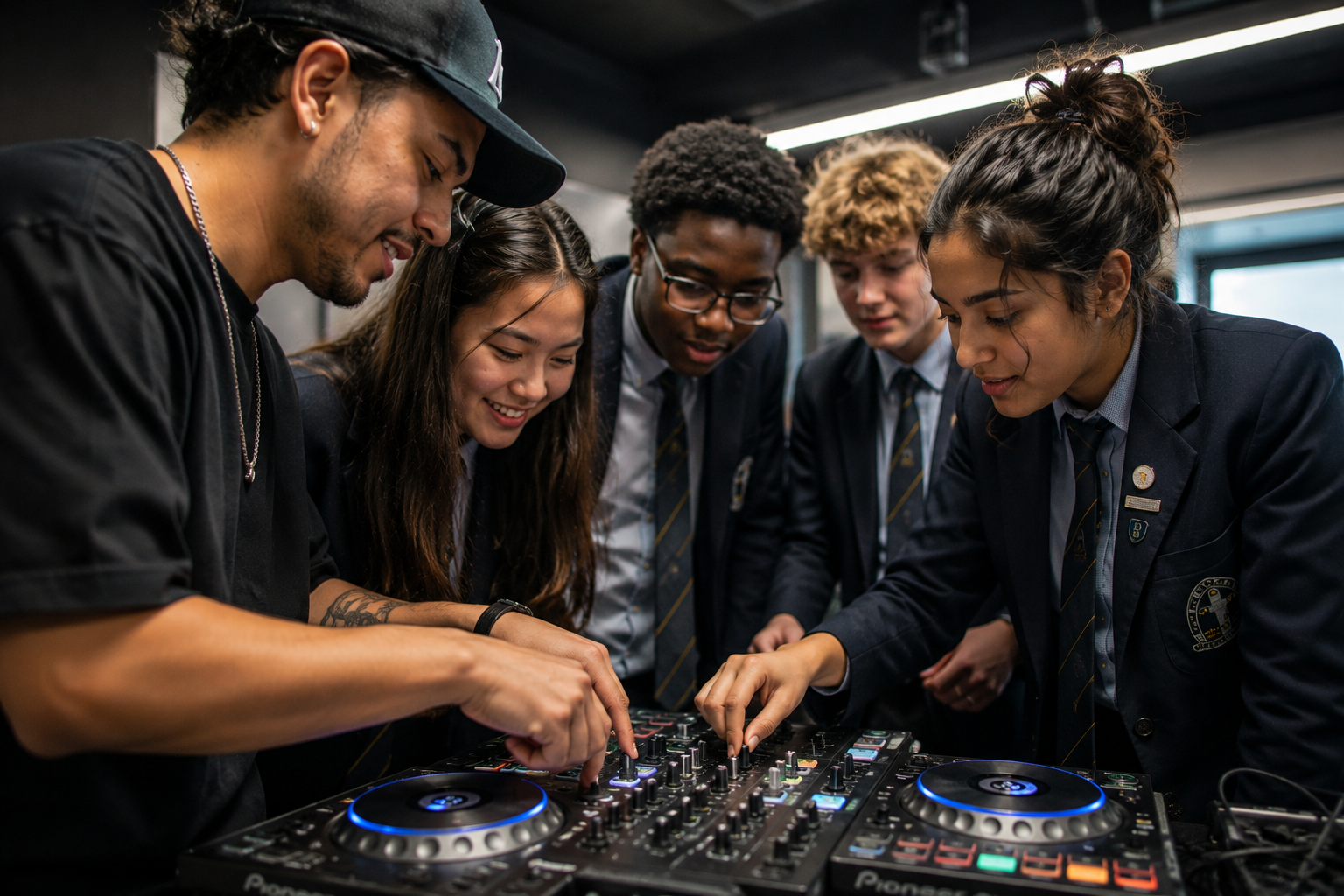
DJing is one of the most effective entry points into music education that exists — and one of the most underused. It's immediately engaging for students who may have never played a traditional instrument, it's rich with curriculum connections across music, technology, history and mathematics, and it teaches skills that are genuinely relevant to how music is made and consumed in the real world. If you haven't brought DJing into your classroom yet, here's where to start.
Why DJing works in the classroom
The first and most obvious reason is engagement. Students who have never shown interest in music class will show up differently when there's a DJ controller on the table. DJing sits at the intersection of music culture and technology in a way that feels authentic to contemporary teenage experience — because it is. The music they listen to was almost certainly produced and mixed by someone working in a DJ or production context.
But engagement is just the hook.
The learning that follows is substantive. DJing teaches:
- Rhythm and timing: Beatmatching — aligning the tempos of two tracks so they play in sync — is an applied lesson in pulse, subdivision, and mathematical ratios. Students who can beatmatch have internalised a deep sense of musical time.
- Listening skills: DJing demands active, critical listening. Students learn to hear the structure of a track, identify the phrase structure and boundaries, and anticipate transitions. This is the same analytical listening we try to develop in music appreciation — DJing just makes it immediately purposeful.
- Music theory in context: Key compatibility, the harmonic relationships between tracks, and the emotional logic of a DJ set, all connect directly to tonal theory. Understanding why two tracks in different keys sound jarring when mixed together is a gateway to understanding harmonic relationships.
- Technology literacy: Signal flow, EQ, effects processing, and gain staging are all part of the DJ workflow. Students develop genuine technical knowledge of how audio systems work.
- Performance skills: A DJ set is a performance. Reading the room, building energy, managing transitions — these are live performance skills that translate across musical contexts.
Getting started: what you actually need
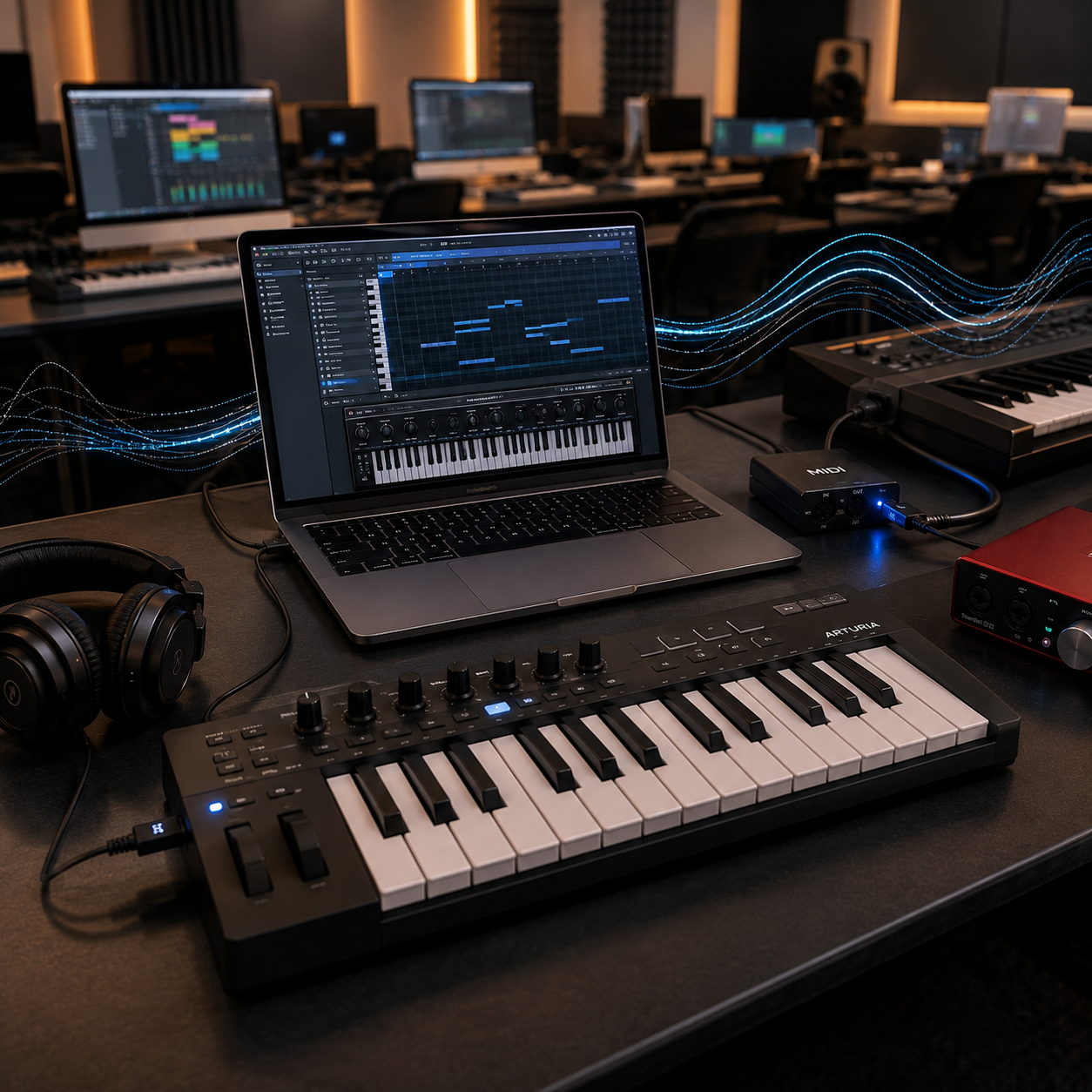
You don't need a professional DJ setup to start. A basic classroom setup for DJing can be as simple as:
- A DJ controller: Entry-level controllers from Pioneer DJ (DDJ-200, DDJ-FLX4), or Hercules connect via USB to a laptop and include software. Prices start around $250–350 AUD and are manageable on a school budget, especially for a set of 2–4 shared units.
- A laptop with DJ software: Most controllers come bundled with a version of Serato Lite or Rekordbox, which are industry-standard. Both have educational pricing, and browser-based options like Mixxx are free.
- Headphones: Each DJ setup needs a pair of over-ear headphones for cueing tracks. Classroom-grade headphones at around $30–50 per pair are fine - however since students will need to have one ear open (listening to the speaker) and one ear covered (listening to the next track & getting it ready to transition seamlessly), flexible headphones are preferable and will save breaking your standard ones.
- A speaker or PA system: Whatever your classroom already has will likely work for small group work. Preferably, speakers should be wired / cabled and not via bluetooth (as this creates latency). For performances, school PA infrastructure is usually sufficient.
- Plastic tubs: yes you read correctly, plastic tubs. One of our teachers came up with this over a decade ago and swears by it. Having a plastic tub for each setup means the gear can be tracked by a simple inventory list on the tub. Additionally, you can allocate the same tub to the same students from lesson to lesson - this subconsciously tells the students that the teacher can track the gear, which in turn minimises theft and damage.
For schools with tighter budgets, tablet-based DJing apps like djay (Algoriddim) or Cross DJ work with basic MIDI controllers and even touchscreens. The workflow is slightly simplified but the core concepts — beatmatching, EQ, transitions — are all still present. The Traktor DJ Splitter cable in these setups are a must as they simulate the split audio of a DJ Controller deck.
Building a DJing unit: scope and sequence
A well-structured DJing unit typically runs 8–10 weeks and can be embedded within a broader music technology or contemporary music program. A framework that works:
- Weeks 1: Introduction to the equipment and software. Students learn signal flow, gain structure, and basic controller navigation. The conceptual focus is on how sound moves from source to speaker.
- Weeks 2–4: Beatmatching and BPM. Students learn to identify tempo by ear and using software analysis, and practise aligning two tracks manually. This is where the mathematics of rhythm becomes tangible.
- Weeks 5–6: Track structure and transitions. Students analyse the structure of DJ-friendly tracks — intro, build, drop, breakdown — and learn to plan and execute transitions at phrase boundaries. EQ mixing (cutting bass frequencies when mixing in a new track) is introduced here.
- Weeks 7–8: Set planning and curation. Students select a set of 6–8 tracks with a coherent energy arc, plan their transitions, and begin rehearsing a 10-minute live mix.
- Weeks 9–10: Performance. Students perform their sets for the class or a small audience, and complete a reflective journal documenting their musical decisions.
DJing and the music curriculum
One of the most common questions music teachers ask before introducing DJing is whether it can be justified against the curriculum. The short answer is yes — and more convincingly than you might expect.
Performance
DJing is a live performance practice. Students develop technical skills on equipment (whether physical controllers or software), build the ability to read a room and respond in real time, and learn to manage the physical and psychological demands of performing in front of an audience. A DJ set has a beginning, middle, and end — and the performer is responsible for all of it. That is performance by any definition.
Composition
Selecting, sequencing, and mixing tracks is a compositional act. Students make deliberate decisions about form and structure — how a set builds, where energy peaks, when to pull back. They work with dynamics consciously, understanding that contrast and tension are tools just as much as a crescendo in a written score. More advanced students begin to layer loops, samples, and effects, moving from curation into original creation.
Theory and Musicianship
DJing has a surprisingly strong theory backbone. Beatmatching develops an acute awareness of duration and metre — students who struggle to feel a pulse in a traditional setting often lock in immediately when the consequence is an audible train wreck on the dancefloor. Key detection and harmonic mixing introduce pitch relationships and tonality in a context that feels immediately relevant. Students start to hear how tracks relate to each other harmonically, which is the same skill underpinning chord progressions and voice leading — just arrived at from a different direction.
Listening
Perhaps the strongest curriculum fit of all. DJing demands active, analytical listening — not passive enjoyment. Students learn to hear texture, to distinguish between frequency layers, to notice how expressive techniques like filtering or reverb change the character of a sound. They develop the ability to compare tracks structurally before deciding whether and how to mix them. This is exactly the kind of disciplined listening that music curricula ask for, applied in a context students are genuinely motivated to engage with.
MusicEDU's TrackFormers program is built around exactly this framework — it provides a structured, curriculum-aligned DJ and beatmaking program that includes all the starter tracks, scope and sequence, student resources, and assessment tools, so you're not building from scratch. But even if you're designing your own unit, the principles above will get you a long way.
The bigger picture
DJing in the classroom isn't a concession to popular culture at the expense of 'real' music education. It is real music education — just delivered through a contemporary medium that meets students where their musical lives already are. The listening skills, the theory, the performance craft, and the collaborative practice are all there.
The controller is just a different kind of instrument.
Like what you read?
You should see our curriculum.
It takes less than a minute to sign up for a Free Trial of The MusicEDU Suite. Your students will thank you for it.