Using AI tools in the music classroom
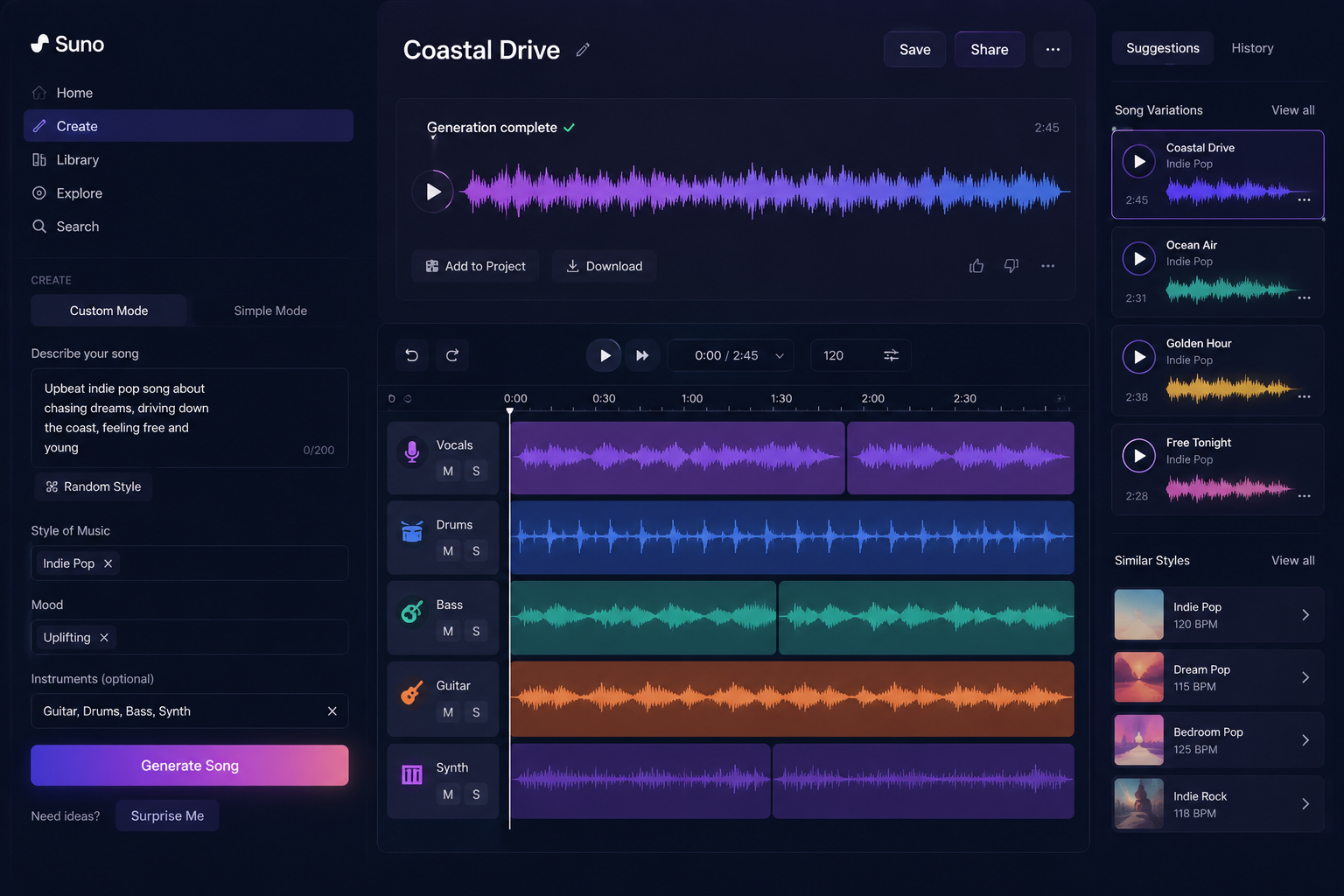
Artificial intelligence has entered the music classroom whether we planned for it or not. Students are already using it — to generate chord progressions, write lyrics, produce backing tracks, and increasingly, to compose complete pieces of music at the click of a button. The question for music educators is no longer whether to engage with AI tools. It's how to engage with them in ways that deepen musical learning rather than bypass it.
What AI music tools can actually do in 2025
The landscape has moved fast. A few years ago, AI music tools were curiosities — capable of generating something vaguely musical but rarely useful in a classroom context. That's changed significantly. Today's tools fall into several practical categories:
- Text-to-music generators (Suno, Udio): Students describe a style, mood, or genre in text, and the tool generates a complete track. The results are impressive enough to be genuinely useful as starting points for discussion, analysis, or remix.
- AI composition assistants (Soundraw, Mubert): Tools that generate royalty-free music based on parameters like tempo, mood, and instrumentation — useful for students creating content for video, games, or podcasts.
- AI-powered notation and theory tools (Hookpad, Noteflight with AI features): Suggest chord progressions, harmonise melodies, and help students understand the 'why' behind musical choices in real time.
- General AI assistants (Claude, ChatGPT): Useful for generating song lyrics, explaining music theory concepts, creating composition briefs, or drafting lyrics for students to then edit and develop.
- AI mastering and mixing (LANDR, iZotope Neutron): Automated mixing and mastering tools that can help students hear a polished version of their productions, useful as both a finishing tool and a reference for mixing decisions.
The real risk: AI as a shortcut around learning
Here's the tension every music teacher needs to navigate. A student who uses Suno to generate a complete track in 30 seconds has produced something. But they haven't composed anything. They haven't made the thousands of micro-decisions that constitute musical thinking. They haven't developed their ear, their theoretical understanding, or their creative voice.
Used poorly, AI tools in music education can create the appearance of productivity while hollowing out the actual learning. This is the same concern teachers have about AI in essay writing — and it's just as real in music. The answer isn't to ban the tools. It's to design tasks that make the human creative process the point, with AI as a resource rather than a replacement.
Classroom approaches that work
The most effective approaches use AI to create more creative decision-making, not less. Some frameworks that work in practice:
- AI as a starting point, not an endpoint: Generate a chord progression or a drum loop with an AI tool, then require students to develop, modify, and build on it. The AI output becomes raw material, not the finished product. Students have to explain every change they made and why.
- AI for comparative analysis: Generate two versions of a musical idea using different AI tools or settings, then ask students to analyse the differences. What makes one more effective than the other? What would you change? This teaches critical listening and musical judgement.
- AI as a 'session musician': Have students write a brief — style, tempo, instrumentation, mood — then use an AI tool to generate something based on that brief. Was the output what they imagined? Where did it diverge? What does that reveal about the brief, and about the limits of language to describe music?
- Remix and critique: Give every student the same AI-generated piece and ask them to remix it — changing elements using a DAW — to express a different emotion or serve a different purpose. The AI provides an equal starting point; the student's creative decisions do the work.
- Theory through AI: Use AI chord progression generators as a jumping-off point for theory lessons. Why does this progression feel tense? What would happen if we substituted this chord? The AI generates the sound; the student develops the understanding.
Copyright, ethics, and the harder conversations
Music educators are also on the front line of one of the most significant ethical debates in creative fields right now: AI tools trained on copyrighted music without artist consent. This isn't just a policy issue. It's a live conversation in the music industry, and increasingly in education policy.
Australia's Copyright Act is under review, and how AI-generated music is treated in educational contexts remains genuinely unclear. The practical implication for classrooms: AI-generated music used for internal educational purposes is unlikely to present significant risk. Publishing or distributing AI-generated work commercially raises more complex questions that are still being resolved at a policy level.
More immediately: these are conversations worth having with students. Where does AI-generated music fit in our understanding of creativity and authorship? What does it mean to 'make' something? How do working musicians feel about their work being used to train these systems? Music classrooms are well-placed to host these discussions authentically, because the stakes feel real.
What AI can't replace
No current AI tool can replicate what happens when a student performs in front of an audience for the first time and manages their nerves or records their first track. Or when an ensemble finally locks in after weeks of rehearsal. Or when a student finds the lyric that says exactly what they've been trying to say. The emotional, social, and embodied dimensions of music-making remain stubbornly human.
The music teachers who will navigate this transition best aren't the ones who reject AI or the ones who uncritically adopt it. They're the ones who stay clear on what musical learning is actually for — and design experiences where AI is a useful tool in the service of that, rather than a substitute for it.
Like what you read?
You should see our curriculum.
It takes less than a minute to sign up for a Free Trial of The MusicEDU Suite. Your students will thank you for it.